
When a project needs a pressure vessel that no catalogue offers, the usual options take a lot of time. A cast or forged part can take 6 to 18 months or more to be finished and delivered, and a one-off shape rarely fits a standard fabrication line. Wire Arc Additive Manufacturing (WAAM) offers another route. A robot builds the vessel layer by layer from metal wire, with its nozzles and connections printed in the same piece.
This is how MX3D makes custom pressure vessels. Printing takes days rather than months, and the vessel stays strong, durable, and built to the same pressure codes as a conventional one. As WAAM works with most weldable metals, we can also match the material to your industry, such as stainless steel, duplex and super duplex, aluminum, and other alloys. To start the process, all we would need is a CAD file. From there, we turn it into a reliable 3D printed pressure vessel, delivered in a short lead time.
Request a quote for your pressure vessel →
When Does a 3D Printed Pressure Vessel Make Sense?
There is more than one way to make a pressure vessel. Classic pressure vessel fabrication rolls steel plate into a shell and welds on the heads and nozzles. It works well for standard cylindrical vessels. Forging and casting are suitable for thick, compact, or heavily loaded parts, but they come with long lead times. WAAM prints the pressure vessel directly from a 3D model.
The best route depends on the size of the vessel, the batch, the complexity of the shape, and your deadline. 3D printing is the strongest option when you need a large or complex vessel quickly, as a one-off or in a small batch. Three things make the difference:
| Advantage | What it means for you |
| Faster | WAAM deposits 2 to 8 kg of metal per hour, and printing starts as soon as the design is ready. You skip the wait for dies, patterns, and forged blanks. |
| Strong and code-compliant | Our pressure vessels are built to meet PED and ASME requirements. |
| Complex shapes | Nozzles, stub pipes and special connections are printed into the shell. That means fewer welded joints to make and inspect. Non-standard shapes need no special tooling. |
Situations Where WAAM Makes the Difference
Beyond these advantages, some projects are a clear match for WAAM:
- One-off vessels and small batches. Casting and forging only pay off over a series, because the tooling has to be made first. Without tooling to pay for, a single printed vessel stays affordable.
- Urgent replacements. When a vessel fails or reaches the end of its life, every week of waiting means downtime. If the original supplier no longer makes the part, we work from the original drawing or reverse-engineer the existing vessel, and print a replacement.
- Special alloys. Duplex, super duplex, and nickel alloys in plate or forged form can have long mill lead times. Welding wire is a standard consumable, so it is usually easier to source.
- Designs to validate. When a design is new, you can print one vessel, test it, and adjust it before committing to a larger order.
If your project matches one of these situations, WAAM is worth comparing with the conventional route.
Standards, Qualifications and Certifications
For a pressure vessel, the code decides how it is designed, built, and tested. We build our pressure vessels in our facility according to the following qualifications and industry standards.
PED (2014/68/EU)
The PED is the European directive for pressure equipment above 0.5 bar. It sorts equipment into four categories, from I to IV, based on the maximum pressure, the volume and the type of fluid. The higher the category, the stricter the conformity assessment. From category II upwards, a notified body is involved, and its role grows with the category. The vessel then receives a CE marking and a declaration of conformity.
Printed metal is not yet covered by the harmonised material standards. For a printed vessel, the material is therefore approved through a Particular Material Appraisal (PMA). For category III and IV vessels, the notified body carries it out.
ASME VIII
ASME BPVC Section VIII is the US code for building pressure vessels. It sets the rules for design, materials, fabrication, inspection, and testing. Division 1 is the most widely used.
ASME IX
ASME IX covers the qualification of welding procedures. WAAM is an arc welding process, so our print procedures are qualified under it. Each procedure is written down in a Welding Procedure Specification (WPS) and proven with test pieces, recorded in a Procedure Qualification Record (PQR). For WAAM, the print parameters are part of this procedure. If a key parameter changes beyond its qualified range, the procedure has to be qualified again.
DNV AMC3
MX3D is the first WAAM facility certified to AMC3, the highest class in DNV-ST-B203, the DNV standard for 3D printed metal parts. The standard sorts printed parts into classes based on what happens if the part fails, and AMC3 covers critical, high-load parts. The audit covered our facility, our MetalXL software and our WAAM procedures, including mechanical testing, material validation and quality control. For you, it means a printed part from our Amsterdam facility comes with a DNV qualification behind it.
Quality and Traceability
Our quality management system is ISO 9001 certified by DNV, and our facility holds an LRQA AM facility qualification. Every vessel is traceable, from the material certificate of the wire to the print data of each layer.
Want to know how certification works for a printed part? Read can WAAM parts be certified?
How We Test Our Pressure Vessels
We check the vessel while it is being printed, not only at the end.
MetalXL process data. MetalXL records interpass temperature, wire feed speed, current, voltage, and torch position for every layer, and maps this data onto the 3D model. It shows where the wall is thinner or thicker than planned, and gives an indication of density. When the data shows a deviation, we adjust the print. The same map tells our inspectors exactly where to look during NDT.
Non-destructive testing and pressure testing. Before delivery, every vessel goes through non-destructive testing: visual inspection, ultrasonic testing, radiography or dye penetrant testing, depending on the material and the geometry. It is then pressure tested. The code sets the test pressure: under PED, at least 1.43 times the maximum allowable pressure; under ASME VIII Division 1, 1.3 times the maximum allowable working pressure.
Destructive testing, on request. For a new design, we can print a spare vessel and pressurize it until it bursts. This shows at what pressure the vessel fails, and how much margin it has above its design pressure.
From CAD File to Tested Vessel: What You Receive
As a custom pressure vessel manufacturer, we handle every step, from your CAD file to a tested vessel with the relevant documents.
- Send your request. Share your CAD file, the material category, and, if applicable, your certification requirement.
- Feasibility and quote. Our engineers check printability, material, and the code route. You get a price and a delivery date.
- Design for printing. We adapt the model for WAAM and agree the test plan with you, and with the notified body if needed.
- Printing. Hours to days, depending on the size of the vessel.
- Post-processing. Heat treatment, milling and machining of flanges and ports, and coating if required, with certified partners.
- Testing and inspection. Pressure test, NDT, mechanical tests, and a dimensional check.
- Documentation and delivery. The vessel ships with its full documentation pack (material certificate and manufacturing dossier).
WAAM Reinforced Pressure Vessel | MX3D Robotic WAAM (Wire Arc Additive Manufacturing) Experts
How Long Does It Take?
Delivery time depends on three things: the geometry, the material and the volume of the vessel. A vessel we have printed before is the fastest, because the print strategy is ready. For a new geometry, we already have proven parameters for common materials such as stainless steel and aluminum. Duplex, super duplex and other alloys take longer. The larger the volume, the longer the printing.
| Geometry | Volume | Delivery time |
| Geometry already printed by MX3D | 0 – 0.5 m³ | 1–2 weeks |
| 0.5 – 1 m³ | 2–4 weeks | |
| 1 m³ and above | 4+ weeks | |
| New geometry in stainless steel or aluminum | 0 – 0.5 m³ | 2–4 weeks |
| 0.5 – 1 m³ | 4–6 weeks | |
| 1 m³ and above | 6+ weeks | |
| New geometry in duplex, super duplex or another alloy | 0 – 0.5 m³ | 4–6 weeks |
| 0.5 – 1 m³ | 6–8 weeks | |
| 1 m³ and above | 8+ weeks |
WAAM Pressure Vessels We Have Printed and Tested
Our custom stainless steel pressure vessel was printed in ER316LSi in 47 hours, on our M1 Metal AM System. The stub pipes and connections were printed directly into the shell, so no extra welding was needed to attach them. The aluminum vessel followed the same route in ER5183, a marine-grade alloy. It shows that WAAM also suits large, lightweight pressure vessels.
WAAM-printed pressure vessels by MX3D: material, size, weight and print time
| Stainless steel vessel | Aluminum vessel | |
| Material | ER316LSi stainless steel | ER5183 aluminum |
| Dimensions | 409 × 409 × 625 mm | 790 × 790 × 1,050 mm |
| Weight | 61 kg | 52 kg |
| Print time | 47 hours | 32 hours |
| Wall thickness | 8 mm | 6 mm |
Client Prototype: A Stainless Steel Water Tank for Fourinox
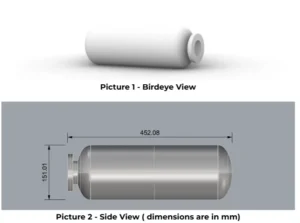
Fourinox needed a pressure tank to hold water, and asked us if it could be 3D printed. To answer that question, we started with a small prototype. We printed the tank in 316L stainless steel: a cylindrical body with domed ends and a flanged connection, about 450 mm long and 150 mm in diameter. We then sent it to Fourinox, who ran their own tests on it. They were satisfied with the results, and the prototype became the start of our collaboration.
FAQ About Custom Pressure Vessels
What is a pressure vessel?
A pressure vessel is a closed container that holds a gas or liquid at a pressure different from the surrounding air. Reactors, separators, air receivers, and heat exchanger shells are common examples. Because a failure can be dangerous, every pressure vessel is designed, built, and tested to a code such as PED or ASME VIII.
How are pressure vessels made?
In conventional pressure vessel manufacturing, steel plate is rolled into a shell, the heads are formed, and the nozzles are welded on. An additive manufacturing pressure vessel is printed layer by layer from a metal wire feedstock, nozzles included. In both cases, the vessel is then machined, inspected, and pressure tested.
What are pressure vessels made of?
Most are made of carbon steel or stainless steel. Duplex, super duplex, aluminum and nickel alloys are used for corrosive, cryogenic, or high-temperature service. For a printed custom steel pressure vessel, the choice depends on the medium, the temperature, and the pressure. Our WAAM material selection guide helps you choose.
What is an ASME pressure vessel?
An ASME pressure vessel is designed, built, and inspected to ASME BPVC Section VIII, the main pressure vessel code in the US. An authorized inspector checks the work, and the vessel receives an ASME stamp. Many buyers outside the US ask for it too, especially in oil and gas.
How to weld pressure vessels?
Pressure vessels are welded by qualified welders, following a procedure tested under ASME IX or EN ISO 15614. Every weld is then checked with NDT. In stainless steel pressure vessel fabrication, low-carbon grades such as 316L (stainless steel) limit corrosion at the welds. WAAM is itself arc welding, so it follows the same qualification rules.
Request a Quote for Your Pressure Vessel
Have a custom pressure vessel to source? Send us your CAD file with the material, the certification you need, the design pressure, and your deadline. Our engineers will come back with the best route, a price, and a delivery date.
