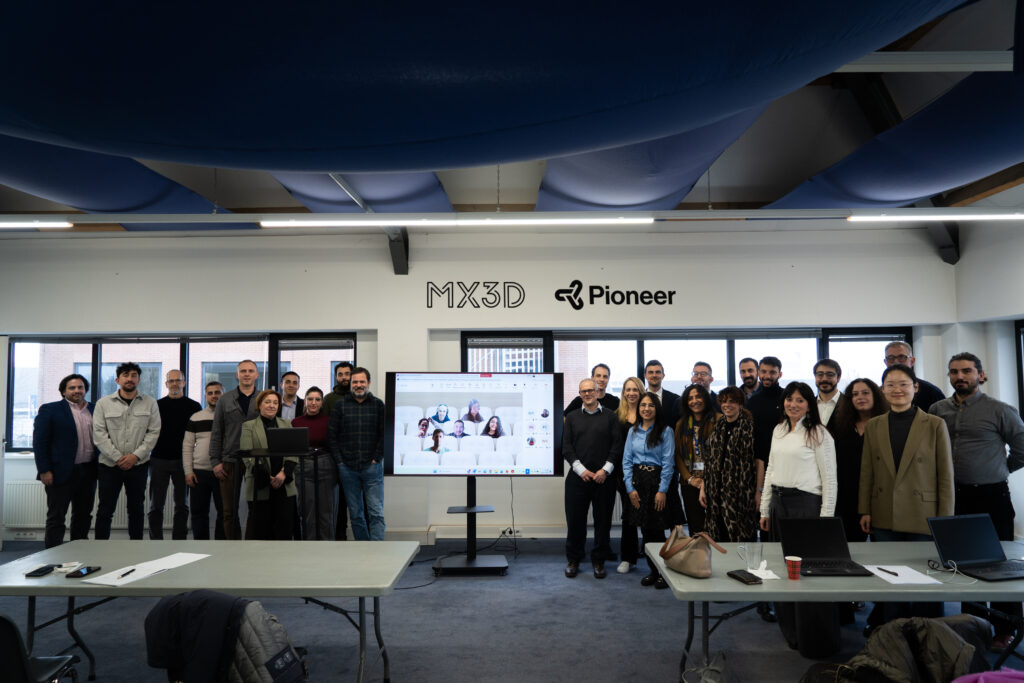
AMSTERDAM, The Netherlands – 03-04-2026 – MX3D, leading innovator in robotic Wire Arc Additive Manufacturing (WAAM) technology, proudly announces the successful completion of the EU Horizon-funded PIONEER project. Serving as a pilot line leader within a premier European consortium, MX3D collaborated closely with partners to industrialize automated design, fabrication and certification of highly optimized, load-bearing hybrid steel components for the civil engineering industry.
One of the key partners in this project, highlighted in this article, is Imperial College London, the department of Professor Leroy Gardner, focusing on structural engineering. Imperial College has been collaborating on testing and approving structural, 3D printed elements with MX3D since 2016 on the famous MX3D Bridge and Integradde, another EU Horizon 2020 project.
The MX3D pilot line demonstrates a novel hybrid design, manufacturing and approval approach that integrates traditional rolled steelwork with parametrically designed WAAM components. By embedding WAAM-specific design principles early in the design and approval process, MX3D’s Pilot Line achieved massive increases in structural load-bearing capacity with minimal extra material added. This strategic reinforcement of conventional profiles enables highly efficient structures, which simultaneously drives a substantial reduction in overall embodied carbon and steel usage, by as much as 50-75% in some applications. This was enabled by a fully deployed digital workflow for zero-defect and certified manufacturing of high-mix, low-volume WAAM components.
Limitstate supported the optimisation module, completely tuned to WAAM connectors. Imperial College London, currently also equipped with one of the world’s most advanced MX3D MX Systems, played a pivotal role in structural design, experimental testing and validation of hybrid components, ensuring their performance under realistic loading conditions. Through their rigorous validation, the project demonstrated several breakthrough structural components:
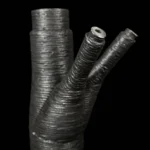
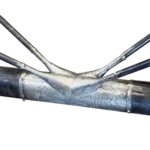
- High-Performance Hybrid Joints: Depositing WAAM material directly onto standard square hollow section (SHS) profiles achieved an average 300% capacity gain with just 100% additional material.
- WAAM-Strengthened I-Beams: Selectively applying WAAM material to structurally critical locations increased load-carrying capacity by 35% to 84% for only a 5% to 16% increase in mass.
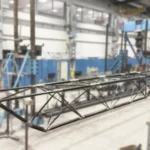
- Full-Scale 10-Meter Hybrid Truss: The project culminated in the production of 22 first-time-right WAAM printed nodes, which were successfully assembled into a 10 m span load-bearing 3D truss.


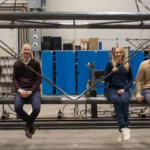
“The PIONEER project demonstrates that hybrid WAAM is not just an innovative idea, but a structurally viable solution,” said Pinelopi Kyvelou, Assistant Professor in Structural Engineering at Imperial College London. “By systematically testing components and full-scale systems, we have been able to demonstrate not only performance gains, but also consistency and reliability, both of which are essential for real-world implementation in structural engineering.”
“Hybrid manufacturing allows us to rethink how steel structures are designed, placing material only where it is most effective,” said Leroy Gardner, Professor of Structural Engineering at Imperial College London. “Rather than relying solely on standard sections, we can now engineer performance more precisely, opening up new possibilities for lighter, more efficient and more sustainable structures.”
“From our side at MX3D, PIONEER showed that WAAM can fit into real production environments for hybrid infrastructure, and that it’s ready to move from pilot projects into broader industrial use, especially as our integrated digital workflows, 3D scanning and smarter toolpath planning have come together in a practical way”, said Filippo Gilardi, R&D Manager at MX3D.
About the PIONEER Project
Funded by the European Union’s Horizon Europe research and innovation programme under Grant Agreement No. 101091449, the PIONEER project brings together a consortium of leading industrial and academic partners to develop interoperable materials modelling and manufacturing solutions. The project aims to accelerate the design and deployment of advanced manufacturing processes across European industries.
Consortium Partners: This breakthrough pilot was made possible by a collaborative European network, including:
- KEYSIGHT TECHNOLOGIES FRANCE S.A.S. (France)
- ENGINEERING – INGEGNERIA INFORMATICA SPA (Italy)
- EGYPTIAN BRITISH BUREAU FOR ADDITIVE MANUFACTURING SERVICES COMPANY (Egypt)
- TRANSITION TECHNOLOGIES PSC SPOLKA AKCYJNA (Poland)
- FANKOM MUHENDISLIK MAKINE ENERJI VE BILGISAYAR TICARET (Türkiye)
- FUNDACION TEKNIKER (Spain)
- ECOLE NATIONALE SUPERIEURE D’ARTS ET METIERS (France)
- CLESGO GMBH (Germany)
- FRAUNHOFER GESELLSCHAFT (SCAI) (Germany)
- PANEPISTIMIO PATRON / University of Patras (Greece)
- CORE KENTRO KAINOTOMIAS AMKE (Greece)
- INNOVATION IN RESEARCH & ENGINEERING SOLUTIONS (Belgium)
- MX3D BV (Netherlands)
- ESI GERMANY GMBH (Germany)
- Associated Partners (UKRI): Imperial College London & LimitState (United Kingdom)
Scientific Publications linked to this project:
- Experimental and numerical investigation of WAAM strengthened steel components: https://doi.org/10.1016/j.tws.2025.113437
For more information on our milestones and to see the team behind the technology, please visit the official project website: https://www.pioneer-project.eu/