
Key findings
|
When a ship needs a propeller that no stock list offers, the usual route takes a lot of time. A cast bronze propeller needs a pattern, a sand mold and a slot at a foundry, and often takes months to be finished and delivered. For a one-off, a replacement or a non-standard diameter, that wait often means a ship out of service. Wire Arc Additive Manufacturing (WAAM) offers another option. A robot builds the propeller layer by layer from metal wire, straight from a 3D model, with no pattern and no mold.
This is how MX3D makes a custom propeller. We print the blades and hub in nickel aluminum bronze (NiBrAl), the standard alloy for ship propellers, without a casting pattern, and then machine and balance them to your specification. Aside from the most popular materials, we use a variety of materials. Printing takes days rather than months, and the propeller stays strong and durable in seawater, as NiBrAl resists corrosion and cavitation. The blades can even be hollow, a design a foundry cannot cast. As WAAM works with most weldable metals, we can also match the material to the application, with CuNi 70/30, stainless steel and duplex for other propulsion and seawater parts. To start the process, all we need is a CAD file, a drawing, or your old propeller to scan. From there, we turn it into a reliable WAAM propeller, delivered in a short lead time.
Request a quote for your propeller
When Does a WAAM Ship Propeller Make Sense?
There is more than one way to make a propeller. Classic ship propeller manufacturing pours bronze or other material alloys into a sand mold made from a pattern, then machines and grinds the casting. Propeller casting works well for a series of identical propellers, because the pattern is paid once and used many times. For a one-off, the pattern, the mold and the queue at the foundry make it slow and expensive. WAAM prints the propeller directly from a 3D model.
The best route depends on the size of the propeller, the batch, the complexity of the blades, and your deadline. 3D printing is the strongest option when you need a propeller or a blade quickly, as a one-off or in a small batch. Three things make the difference:
| Vantaggio | Cosa significa per te |
| Più veloce | No pattern or mold to make, and no foundry slot to wait for. Printing starts as soon as the design is ready, and WAAM deposits 2 to 8 kg of metal per hour. |
| Strong and class-ready | In our tensile tests, every printed NiBrAl specimen exceeded the class minimums for propeller bronze: at least 715 MPa tensile strength (590 MPa required), 403 MPa yield strength (245 MPa required) and 30% elongation (16% required). Every propeller is machined to the ISO 484 accuracy class you order. |
| Forme complesse | The geometry comes from a digital file, not a mold. Hollow blades, skewed blades and non-standard diameters are all just different designs in a digital library, with no special tooling. |
Situazioni in cui WAAM fa la differenza
Oltre a questi vantaggi, alcuni progetti sono chiaramente adatti al modello WAAM:
- One-off propellers and small batches. A pattern only pays off over a series. Without tooling to pay for, a single printed propeller stays affordable.
- Urgent replacements. When a propeller is damaged by grounding or debris, every day in port means lost revenue. If the original manufacturer no longer supplies it, or the pattern is lost, we work from the original drawing or scan the existing propeller, and print a replacement.
- Single blades. On a controllable-pitch propeller or a thruster, the blades are bolted to the hub. We can print one replacement blade instead of a complete propeller.
- Repair. A worn or damaged propeller can often be repaired instead of replaced. See Ship Propeller. See ship propeller repair with WAAM below.
- New blade designs. Hollow or optimized blades can be printed, tested and adjusted before you commit to a larger order.
Se il tuo progetto rientra in una di queste situazioni, vale la pena valutare il WAAM rispetto all’approccio tradizionale.
Ship Propeller Repair with WAAM
A damaged propeller does not always need to be replaced. Cavitation erodes the blade surface, debris and groundings chip or tear the edges, and blade tips can break off. With WAAM, we add metal back exactly where it is missing and keep the rest of the original propeller.
The process starts with a 3D scan of the damaged propeller. We compare it with the original design, or with the undamaged blades, to see how much material is missing. After the damaged area is ground clean, the robot deposits material layer by layer to rebuild the edge, the tip or the eroded surface. The blade is then machined back to its original profile, checked with dye penetrant testing and balanced again.
A repair keeps your propeller, its fit on the shaft and its documentation, and avoids the wait for a new one.
Class Rules, Qualifications and Certifications
For a ship propeller, the classification society of the vessel decides which material, which maker and which checks are accepted. We print our propellers in our Amsterdam facility according to the following rules, qualifications and standards.
Class Rules for Ship Propellers
Classification societies such as DNV, Lloyd’s Register, Bureau Veritas and ABS share the same base rules for propeller bronze (IACS UR W24). Nickel aluminum bronze is grade CU3, with a minimum tensile strength of 590 MPa. The surveyor inspects every propeller, and each one ships with a certificate of its chemistry and test results.
These rules were written for cast propellers. A printed propeller is therefore approved through the society’s rules for additively manufactured parts, with a qualification plan agreed with the surveyor before printing. Approval is given per propeller or per application, not as a blanket approval. Propeller additive manufacturing already has a track record: a WAAM propeller was first class approved in 2017, after bollard pull, crash stop and speed trials on a tug, and printed propellers have since been recognized by Lloyd’s Register and ABS.
ISO 484 Accuracy
ISO 484 sets the manufacturing tolerances of ship propellers. Part 2 covers diameters from 0.8 to 2.5 m, and Part 1 everything larger. You choose the accuracy class: S (very high accuracy), I, II or III (wide tolerances). In class S, the mean pitch of the propeller must be within ±0.5% of the design; in class III, within ±3%. A WAAM propeller is printed near-net-shape, with extra material on the blades and the hub, then machined to the class you order.
DNV AMC3
MX3D is the first WAAM facility certified to AMC3, the highest class in DNV-ST-B203, the DNV standard for 3D printed metal parts. The standard sorts printed parts into classes based on what happens if the part fails, and AMC3 covers critical, high-load parts. The audit covered our facility, our MetalXL software and our WAAM procedures, including mechanical testing, material validation and quality control. For you, it means a propeller printed in our Amsterdam facility comes with a DNV qualification behind it.
Qualità e tracciabilità
Our quality management system is ISO 9001 certified by DNV, and our facility holds an LRQA AM facility qualification. Every propeller is traceable, from the material certificate of the wire to the print data of each layer.
How We Test Our Propellers
We check the propeller while it is being printed, not only at the end.
MetalXL process data. MetalXL records interpass temperature, wire feed speed, current, voltage and torch position for every layer, and maps this data onto the 3D model. It shows where a blade is thinner or thicker than planned, and gives an indication of density. When the data shows a deviation, we adjust the print. The same map tells our inspectors exactly where to look during NDT.
Dimensional check. After machining, the propeller is scanned and compared with the 3D model. Pitch, blade thickness and diameter are checked against the ISO 484 class you ordered.
Non-destructive testing. Every propeller goes through visual inspection and dye penetrant testing for surface cracks, with ultrasonic testing or radiography where required. The blade root on the pressure side gets the most attention: it carries the highest stress, and class rules treat it as the most critical zone. Read more about non-destructive testing of WAAM parts.
Balancing. The propeller is statically balanced before delivery, so it runs without vibration on the shaft.
Destructive testing, on request. Test pieces printed in the same build are used for tensile, hardness and cross-section tests. For a new design, we can print a spare blade section and cut it open, to check the density and the walls of hollow blades.
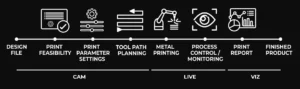
From CAD File to Delivered Propeller: What You Receive
Unlike most ship propeller manufacturers, we need no pattern. We handle every step, from your file or old propeller to a tested propeller with the relevant documents.
- Send your request. Share your CAD file or drawing, or the details of the propeller to replace: diameter, number of blades, pitch, rotation direction and shaft fit. Add the material and, if applicable, your class requirement.
- Feasibility and quote. Our engineers check printability, size, material and the class route. You get a price and a delivery date.
- Design for printing. We adapt the model for WAAM, add machining allowance, and agree the test plan with you, and with the classification society if needed. If you have no 3D model, we scan your existing propeller first.
- Printing. Hours to days, depending on the size and geometry of the propeller.
- Post-processing. Heat treatment where needed, CNC machining of the blades and the hub bore, polishing and balancing, with certified partners.
- Testing and inspection. Dimensional check to ISO 484, NDT, mechanical tests, and a surveyor’s witness if required.
- Documentation and delivery. The propeller ships with its full documentation pack: material certificate, build data, NDT, dimensional and balancing reports, and the class certificate if required.
Quanto tempo ci vuole?
Delivery time depends mainly on the weight and the size of the propeller. Our deposition rate is 2 to 8 kg of metal per hour, so the heavier the propeller, the longer the print. Thin or hollow blades print more slowly, because each layer needs time to cool before the next one is added.
You get an estimated delivery date with your quote. From there, our engineers accompany you through every step, from the design check to the final inspection, and keep you updated as the propeller moves forward. If a classification society is involved, we plan the tests and the surveyor’s visits together with you.
WAAM Propellers We Have Printed
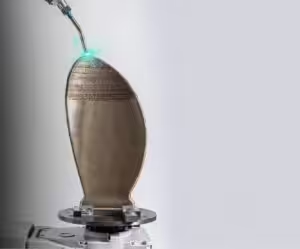
Our NiBrAl propeller was printed in nickel aluminum bronze. Its blades are hollow, in two of the most common blade shapes, and were post-processed after printing. It shows that WAAM prints blade geometry as designed, including hollow sections that a foundry cannot cast. Read the full story in our bronze propeller case.
WAAM printed NiBrAl propeller by MX3D: blades, size, weight
| Item | NiBrAl propeller |
| Materiale | Nickel aluminum bronze (CuAl8Ni6 wire) |
| Diameter | 678 × 563 mm/blade |
| Blades | 5 |
| Peso | 200 KG |
| Tempo di stampa | 80 hours |
FAQ About Ship Propellers
How are ship propellers made?
Most marine propeller manufacturers cast propellers in bronze: a pattern is made, bronze is poured into a sand mold, and the casting is machined, ground and balanced. A WAAM propeller is printed layer by layer from metal wire, without a pattern. In both cases, the propeller is then machined to the ordered ISO 484 class, balanced and inspected.
Why are ship propellers made of bronze?
Bronze resists seawater corrosion and cavitation, the pitting caused by vapor bubbles collapsing on the blades. It is strong, easy to machine and can be repaired by welding. A nickel aluminum bronze propeller is the most common choice for workboats, offshore vessels and ferries, while high-strength manganese brass is used for less demanding service.
What is the difference between bronze and NiBrAl?
Bronze is a family of copper alloys. NiBrAl, or nickel aluminum bronze, adds aluminum, nickel and iron to copper. It is stronger than manganese bronze and resists cavitation and seawater corrosion better. Class rules list it as grade CU3, with a minimum tensile strength of 590 MPa, against 440 MPa for high-strength brass. See our bronze and copper alloy 3D printing page for grade data.
How big are ship propellers?
It depends on the vessel. Propellers on tugs, ferries and offshore vessels are usually between about 1 and 5 m in diameter. A large ship propeller on a container ship can reach more than 10 m and over 100 tonnes.
Can a WAAM propeller be class approved?
Yes. The vessel’s classification society approves a printed propeller per part or per application, through its rules for additively manufactured parts. We agree the qualification plan with the surveyor before printing. MX3D’s facility is certified by DNV at AMC3, the highest level for printed parts, and qualified by LRQA.
Can you print a single replacement blade?
Yes. On controllable-pitch propellers and many thrusters, the blades are bolted to the hub, so one damaged blade can be replaced on its own. We print it from your drawing or from a scan of an existing blade, then machine and inspect it like a complete propeller.
Do I need a 3D model of my propeller?
No. A drawing is enough, and if you have neither, we can scan your existing propeller, even a damaged one, and rebuild the 3D model. For a worn propeller, our engineers check the scanned geometry against the original design data before printing.
Request a Quote for Your Propeller
Have a propeller to source? Send us your CAD file or drawing, or tell us about the propeller you want to replace, with the diameter, the number of blades, the material, the class society and your deadline. Our engineers will come back with the best route, a price, and a delivery date.
